
Why healthcare network decisions need an evidence trail—not another score
A provider score can summarize a comparison. It cannot explain the cohort, source evidence, relationships, assumptions, exclusions, and unresolved questions behind a consequential network decision.
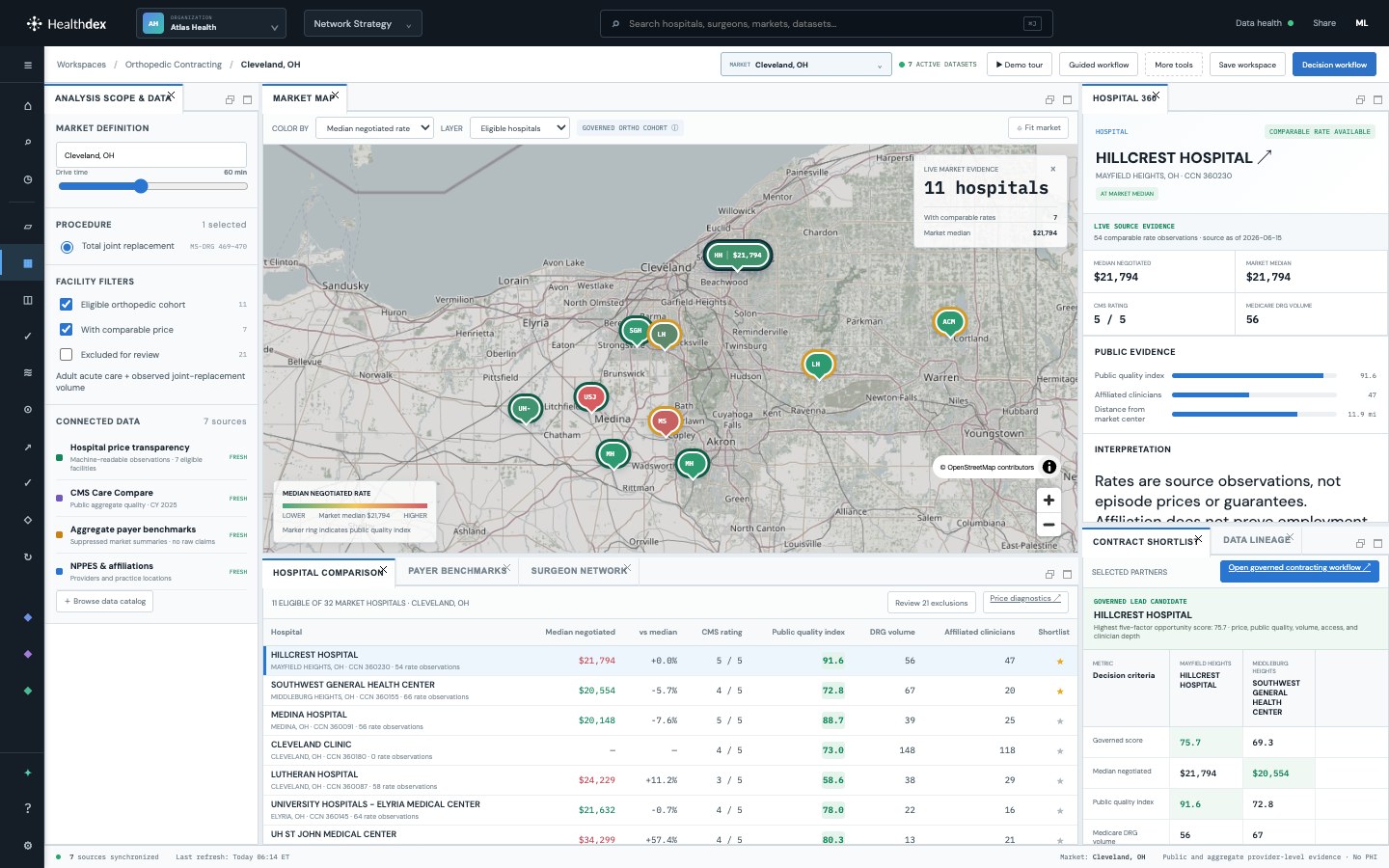
A score is useful. It is not an explanation.
Healthcare network decisions rarely begin with one clean question or one complete dataset. A health plan may be trying to close an access gap, strengthen a service line, evaluate a contracting opportunity, or understand whether a provider belongs in a comparison cohort. The answer can depend on negotiated rates, quality, utilization, geography, clinician depth, affiliations, market need, and the rules used to connect those facts.
Compressing all of that into a single number can help organize a review. Treating that number as the decision is where the trouble starts.
The problem is not a lack of data
Healthcare organizations already have more data than most teams can evaluate comfortably. The harder problem is preserving context as information moves from source files into a recommendation.
A rate observation has a payer, plan, billing entity, service description, reporting period, and file version. A quality measure has its own reference period and denominator. A clinician-to-facility relationship may be observed in one source without proving employment, privileges, procedure activity, or network participation. A distance calculation may reflect a market centroid rather than member travel time.
Those distinctions matter. When they disappear, a precise-looking answer can become less defensible than the fragmented evidence it replaced.
A composite score is a summary, not the source of truth
A weighted score can be valuable when its purpose is clear. It can make tradeoffs visible, support scenario testing, and help a team focus its review. But the score should sit at the end of an evidence chain, not replace it.
Before relying on a score, a reviewer should be able to answer:
- Which providers were eligible for comparison, and why?
- Which providers were excluded?
- Which measures were available, missing, stale, or not comparable?
- How were price, quality, access, utilization, and network depth weighted?
- What changed when an individual factor was removed?
- Which relationships were directly observed, and which conclusions were inferred?
- Which source versions produced the result?
If those answers are not available, the score may be convenient, but it is not yet decision evidence.
What an evidence trail should preserve
A useful evidence trail does not need to make the decision process complicated. It needs to keep the important choices attached to the result.
At minimum, it should preserve:
- The decision being made and the person or team that owns it.
- The market, service line, time period, and population boundary.
- The comparison cohort and the rules used to construct it.
- The exact source versions and freshness dates used in the analysis.
- Entity-resolution decisions connecting facilities, clinicians, organizations, and locations.
- Missing information, exclusions, and comparability limitations.
- The weights, thresholds, and assumptions applied by the analyst.
- Sensitivity tests showing whether the recommendation changes under reasonable alternatives.
- Review comments, unresolved questions, and the rationale for the final recommendation.
This is the difference between delivering data and supporting a reproducible decision.
An illustrative orthopedic-network example
Consider an illustrative health plan evaluating an orthopedic access gap in Northeast Ohio. The team does not begin by asking which hospital has the highest score. It begins by defining the decision.
The market and service line are established. A governed comparison cohort is created. Candidate facilities and surgeons are identified. Available negotiated-rate observations, public quality measures, utilization, geographic access, and clinician affiliations are compared. Source records and relationships are inspected. Assumptions are reviewed. The recommendation is then exported with the evidence package behind it.
That sequence matters because each step can change the conclusion. A facility with an attractive observed rate may have incomplete comparability. A high-volume institution may lack an acceptable rate observation. A reported clinician affiliation may indicate a relationship without establishing employment or network participation. A geographically close provider may not solve member-level access.
The public sample market demonstrates this workflow with illustrative information. It is not a validated market estimate or a recommendation to contract with a particular provider. Its purpose is to show what the decision trail should contain.
Relationships require evidence, dates, and restraint
Provider intelligence becomes especially vulnerable to overstatement when records are connected across sources. The same hospital may appear under multiple names and identifiers. A clinician may be associated with a practice, facility, health system, or location in ways that change over time.
A responsible analysis should show why two records were connected, what source supports the relationship, when it was observed, and how confident the team should be in using it. It should also say what the relationship does not prove.
This is why relationship-aware analysis is not the same as adding more columns to a flat file. The connection itself is part of the evidence.
Better review changes the quality of the decision
An evidence trail improves more than auditability. It changes the working conversation.
Instead of debating whether a score feels right, reviewers can examine the cohort, challenge a weight, inspect a missing observation, or test an alternative assumption. Contracting, network, finance, clinical, and market teams can disagree about the decision without losing track of the facts. When the data changes, the analysis can be reproduced against a new source version rather than rebuilt from memory.
That does not eliminate judgment. It makes judgment visible.
What good looks like
A defensible network recommendation should be understandable by someone who did not build the analysis. That person should be able to move from the recommendation back through the assumptions, comparison cohort, relationships, measures, and original sources.
The objective is not to avoid summarization. It is to keep summarization from hiding the decision.
Healthdex is being built around that principle: source-faithful evidence, inspectable relationships, visible assumptions, and reproducible analysis. You can review the data and methodology, explore the guided decision walkthrough, or discuss a specific network decision.